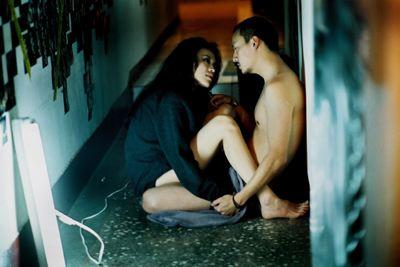
The film is beautiful, of varied beauty, three times beauty. Each of the three time periods, each of the film’s three acts, maintains the kind of tight set design you’d expect from the work Christopher Doyle (thought it’s not Doyle). It has a bit of Wong Kar Wai’s In the Mood for Love, as well as a bit of the more recent cyber alienation that seems to structure a lot of contemporary Korean films (hit Redial for murder… Hitchcock in the East…). On one level the film is an allegory of Chinese-Taiwanese relations. From the first act, in which the characters flirt but are unable to consummate their affections; to the second act, brilliantly done as a silent, in which the two characters are separated by codes of ownership, by the dark smear of prostitution as left by the thumb of time passing through the pages of history, painting in its wake a gulf between the two countries; and to the third and ambiguous present act, in which the characters, now teens, blow through city streets on a moped made for mayhem, cellular connections cut by the winds of time.
The film has a genuine cinematic effect. It did not grab my attention when I saw it; but then nor would it let me go once when it was over. I got particularly stuck on the silent film that is the second act. When film makers declare their preference for black and white because it has richer colors, it’s a “Yes, that makes sense.” Well there’s a similar artistry in Hou’s use of silence and subtitles. These subtitles trailed the dialog. Are they always done that way? The characters spoke. And then the subtitles appeared. As if to allow us to hear them in silence, as if their silence was not just the style of silent film, but something more.
Don’t invite your friends to see this one. It would be better alone. It’s a film to keep and hold.
Technorati tags: analysis, cinema, dvd, films, foreign, indie,movies, movie-reviews, movie reviews, reviews, video
nice site you have, have a look at http://www.badmovieknights.com/ when you get time ;)!