Gravity7 Conversational AI

Gravity7

Social interaction design conversational AI generative AI genAI methods user experience interaction design

Generative AI presents a paradigm shift in human-computer interaction. It's an opportunity for product design, interaction design, organizational design, and design theory generally. If the models come through on their promise, conversation will provide us with a new modality for interaction with countless products, apps, and experiences. Combined conversation and image, video, and camera will only add to this. These changes will demand new approaches to communicating with AI and interacting with its responses and outputs. To date, much of this has been in the domain of NLP and machine learning developers. More should be taken up by user experience and interaction design.

My interest in UX has always been supplemented by an interest in technology and society. Over the years this coupling has become ever tighter and more problematic. AI promises to intensify this coupling even further, causing impacts on people and society in ways that previous technologies, including social and digital generally, have not. AI will cause us to reassess our ideas and expectations of intelligence, authorship, creativity, trust, and integrity. The technology industry will not supply answers, and designers can and should play a role in AI's evolution.

We learned from social media and social platforms that social technologies have social consequences. That the changes wrought by mediation of interaction and communication, of presence and of relationships, cause downstream impacts. Generative AI will do the same, and while not yet being a social engine, will soon disrupt and possibly corrode social and knowledge platforms profoundly. As we adapt to AI's "cognitive" abilities, we will have to reconfigure many forms of knowledge and creative work. Design can and should play a role here. But we will need new concepts.

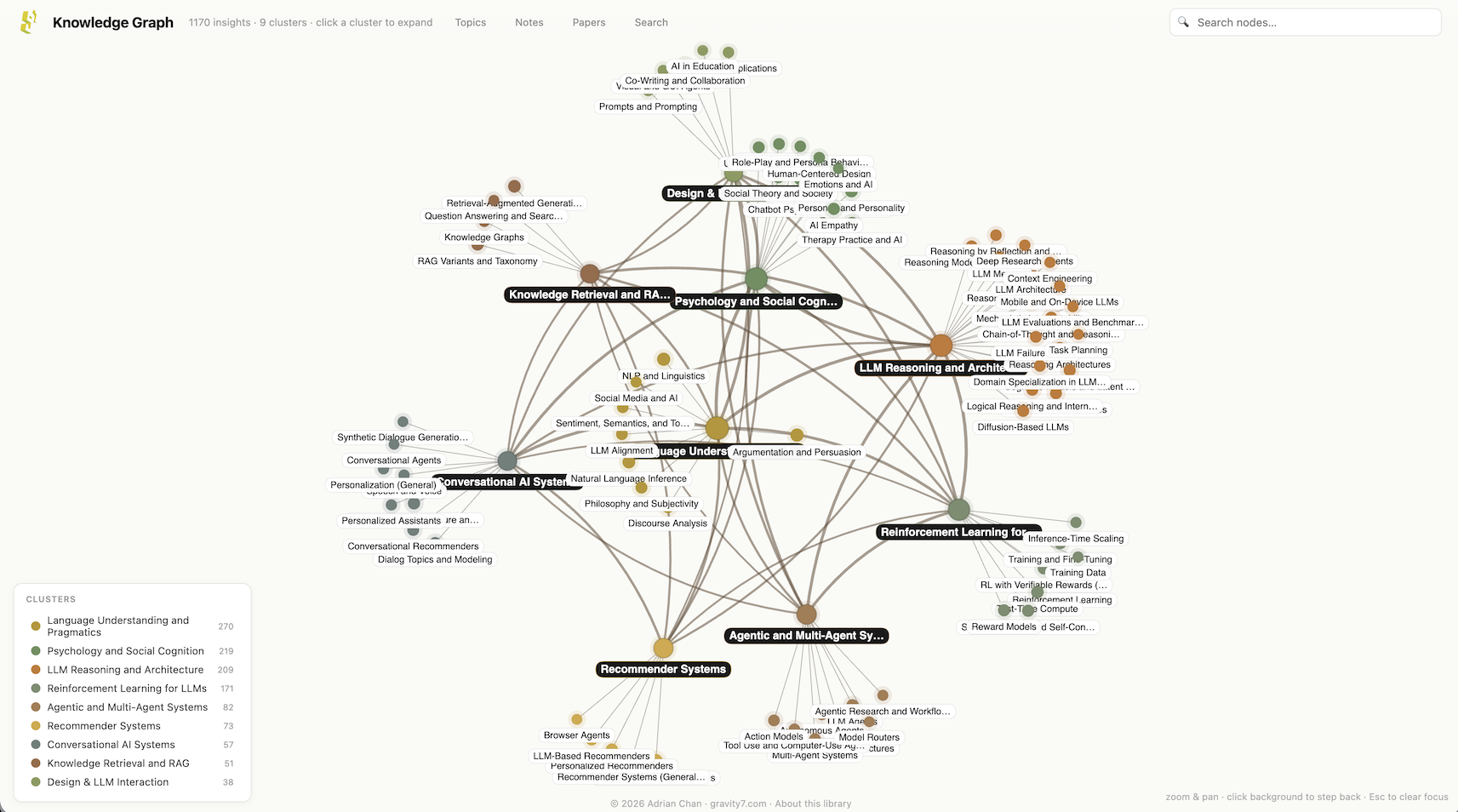
I have now read possibly three thousand AI whitepapers, focusing on conversational AI, question-answer systems, recommender systems, personalization, personas, psychology and AI, agents, reasoning, domain-specific AI, reinforcement learning, mechinterp, and more. More recently (now that tools have matured), I've moved my Obsidian vault of whitepapers online. You can browse excerpts there, using research topics and questions that serve as a layer connecting related papers.

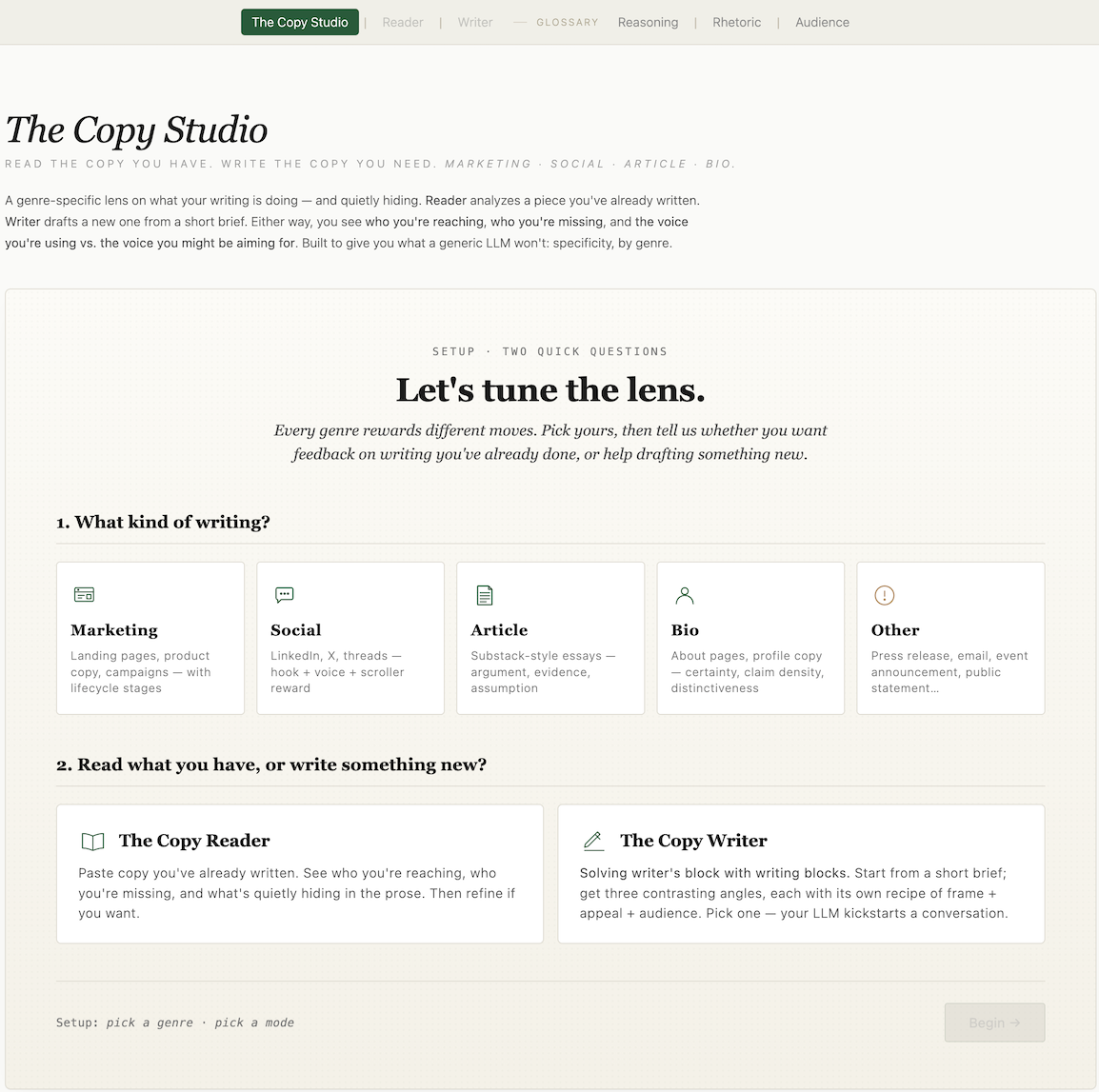
You can also try a tv show recommender proof of concept built on audience reviews and featuring a persona analysis. It's about 300 shows reflecting many of my personal favorites and skewing to UK and Scandinoir crime and drama. I also have a Copy Studio that allows you to use a Copy Reader to improve or critique copy for reasoning, rhetoric, and audience targeting. Or a writer's block writing block flow that kicks off a writing conversation in your preferred LLM. For a one-page streamlined but live LLM analysis, Studio Critic also analyzes reasoning, rhetoric, audience, and AI tells in pasted social posts, articles, and other posts.

Featured

Demo

Binge

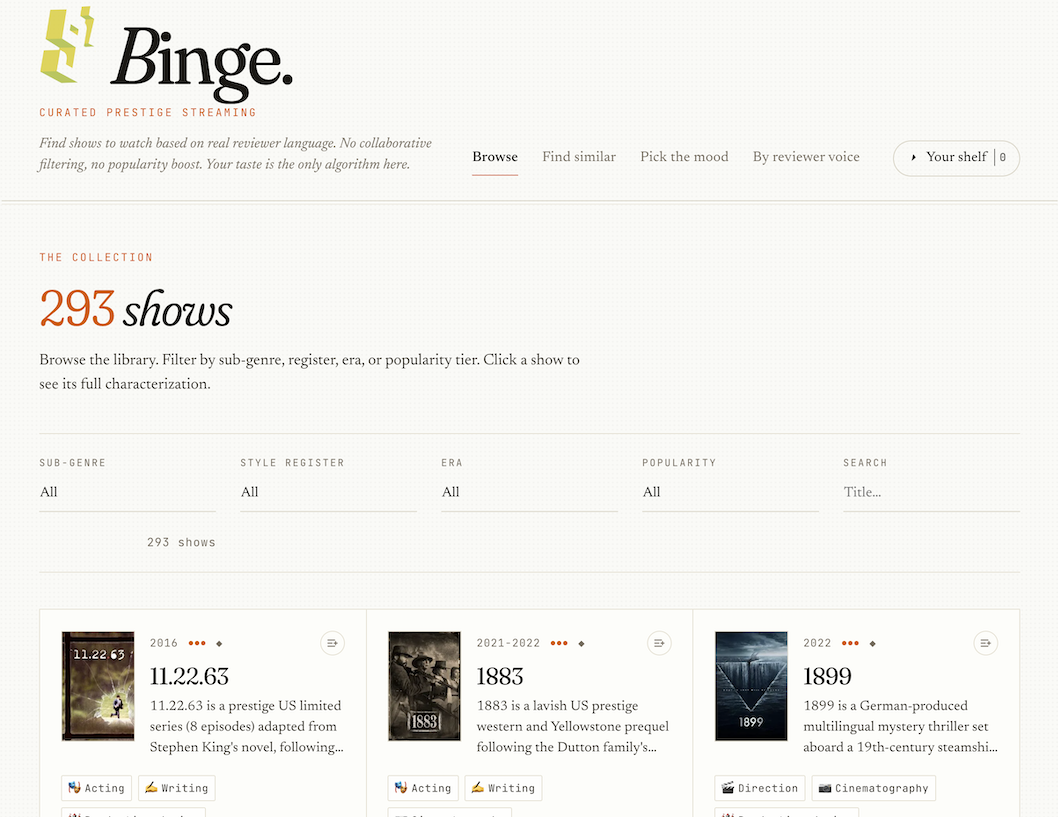
An Proof of Concept TV and Streaming Recommender based on reviews instead of "More Like This" recommendations. Find streaming shows based on what people say, think, and feel about them. It's a demo of using AI to mine semantic similarities in audience commentary. Built with Claude.

Try it →

Text Analyzer

Studio Critic

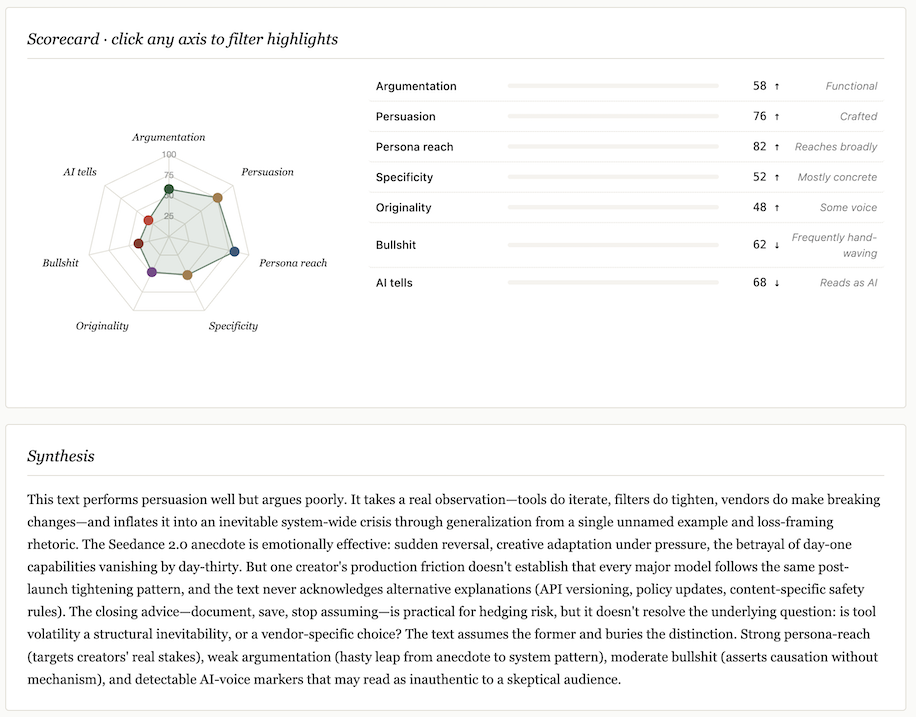
An Proof of Concept Studio Critic. Paste articles, social posts, web site copy and analyze it for reasoning, rhetorical styles, AI tells, and audience personas. Save the output as a PDF, downloadable, report card, or full image. This studio critic is a one-page flow and calls an LLM dynamically.

Try it →

Tool

The Close Reader

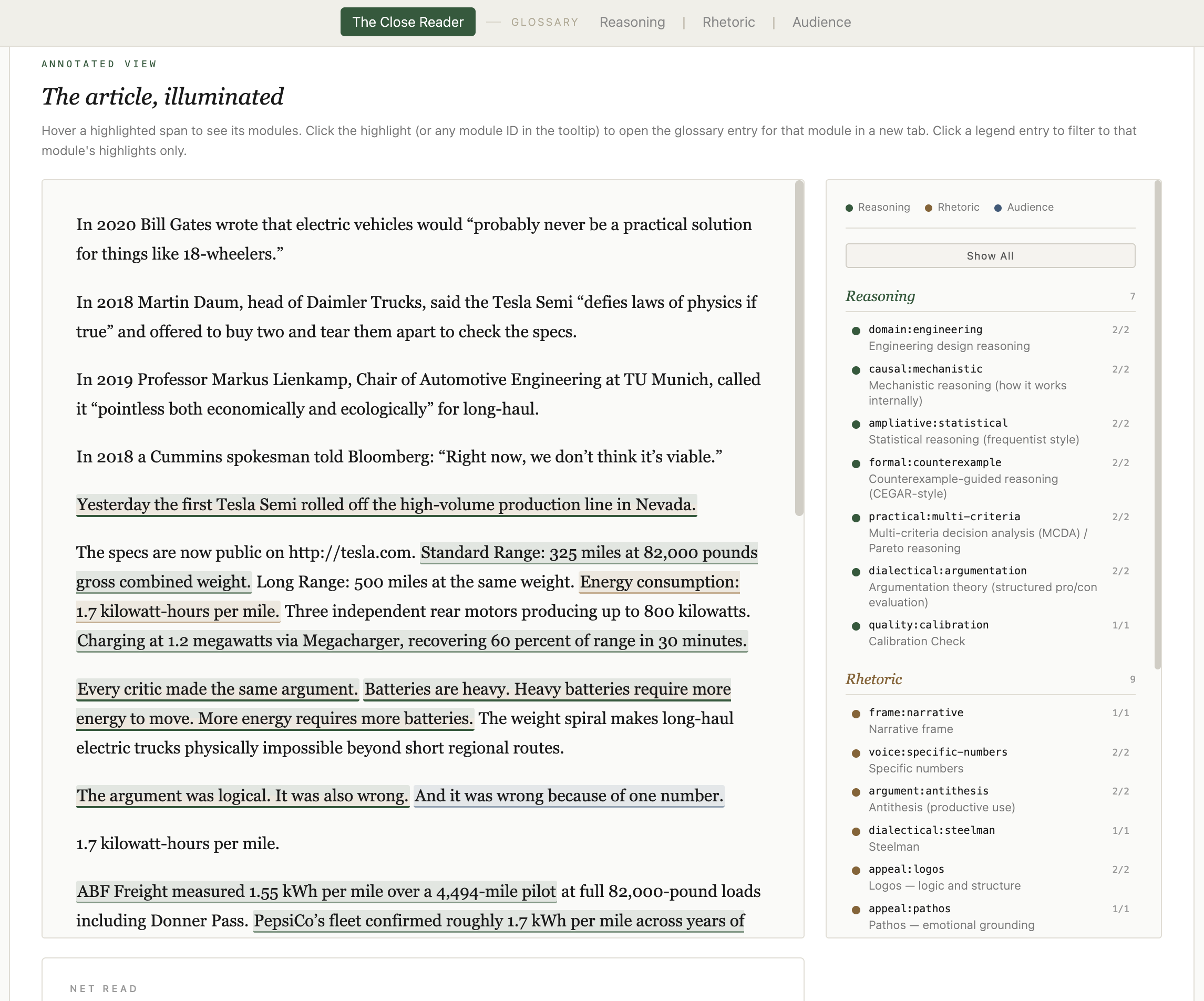
Copy and paste a blog post, LinkedIn post, tweet, or other article into the window. Click to generate markdown. Copy that into Claude, ChatGPT, or another LLM. Copy what you get back into the next panel and view a linguistic analysis of the reasoning, rhetoric, and targeted audiences used in the post.

Try it →

Three-part essay

The Reader Who Wasn't Reading

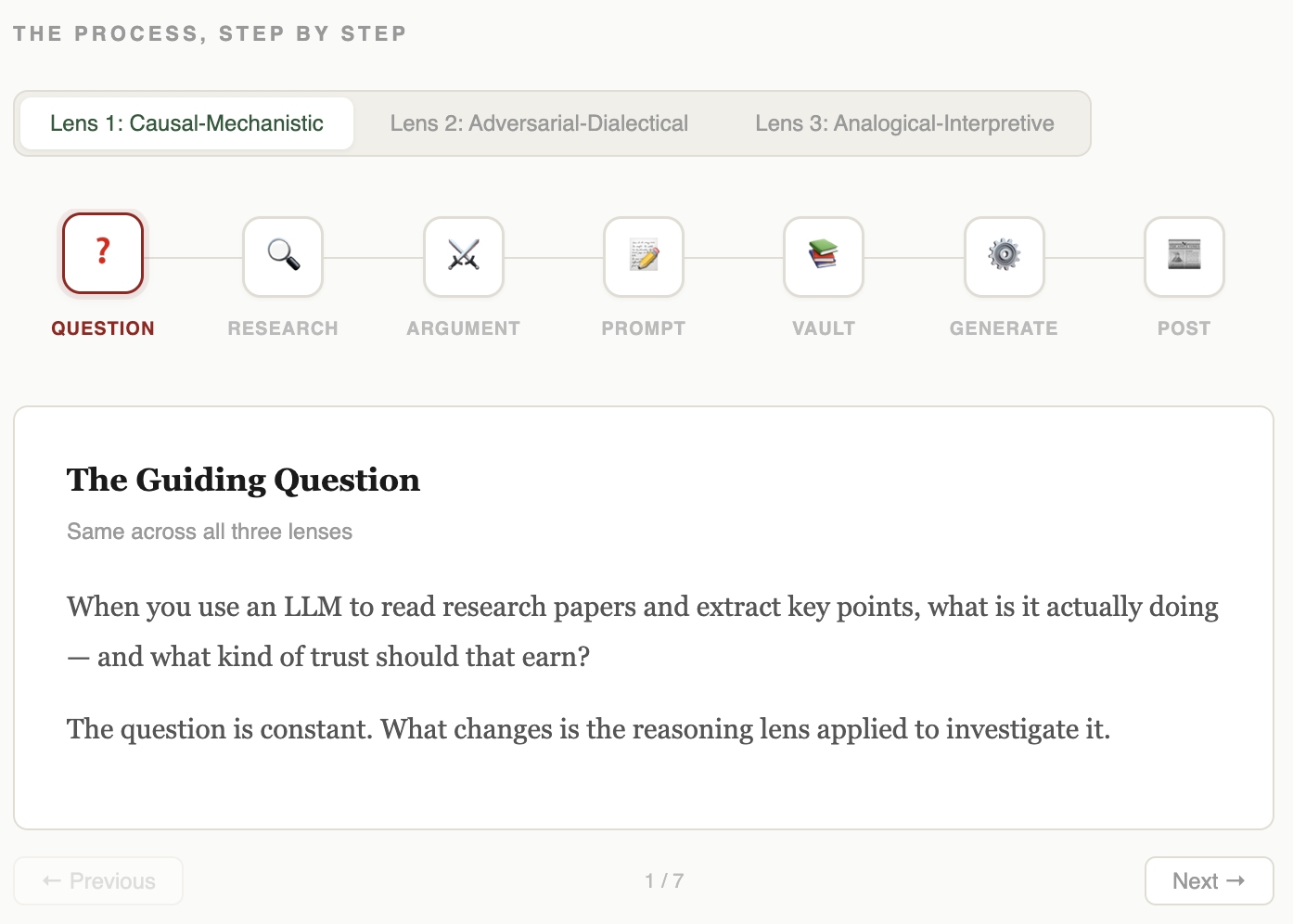
One research question, three reasoning approaches, three prompts, and three posts. A look at how prompting with different reasoning modules produces posts that make different arguments. Another experiment using Claude on an Obsidian vault of white paper research.

Read →

Essay

Knowledge Custodians

What impact will AI have on knowledge work, and on the role and status of the expert? I examine what makes expertise and how AI will reshape how it is produced and what qualifies it.

Read →

PDF · 2012

Principles of Social Interaction Design (SxD)

An exploration of the key concepts of social interaction design, from the logic of online social interaction to reflections on designing social tools and user experiences. I break down the relationship between individual user and social practices and how they relate to common interface design aspects of social tools, sites, and software.

Download PDF →

Selected Medium.com, AI, & SxD blog posts

©2007 - 2026 by Adrian Chan. All Rights Reserved.
San Francisco, California