For an industry that once championed disruption, the disruption wrought by AI and Large Language Models has proven a challenge. Design, be it user experience design, interaction design, user interface design, information or service design, is now forced to adapt to and adopt AI. Where once AI was considered a threat do design jobs, it's now an augmentation, a tool, and accelerant. The performance, speed, and time gains created by AI are simply too great to ignore.
When it comes to design contributions to AI, however, the picture is less clear. Not only is conversation a dominant mode of interaction with LLMs, AI is increasingly automating tasks and workflows such that we provide oversight and supervision. Even this is at risk, as the human-in-the-loop paradigm threatens to become the human-as-bottleneck paradigm.
My primary interests are in conversational AI, and the nuances that apply to the experience design of interactions with AI by chat, text, and voice. Having practiced social interaction design (SxD) previously and for social networking, social tools, and social media, social dimensions of AI are a nascent interest as well.
I maintain a large vault of AI white papers and excerpts, mostly from Arxiv.org, in an Obsidian vault that has been mapped to create topic notes. I use Claude against this vault to research concepts and insights, and to write. A growing number of examples of these projects can be found here, along with prior SxD articles, research, and blog.
Large language models "read" and generate text and documents, generating writing and documents in response. Language models also converse, using styles that are chat conversation or voice-based conversation. From an interaction desigbn persepctive, these are different modes of communication. The conventions common to speech and talk are distinct from those that shape discourse, even while both use language (and language is the foundation of LLMs).
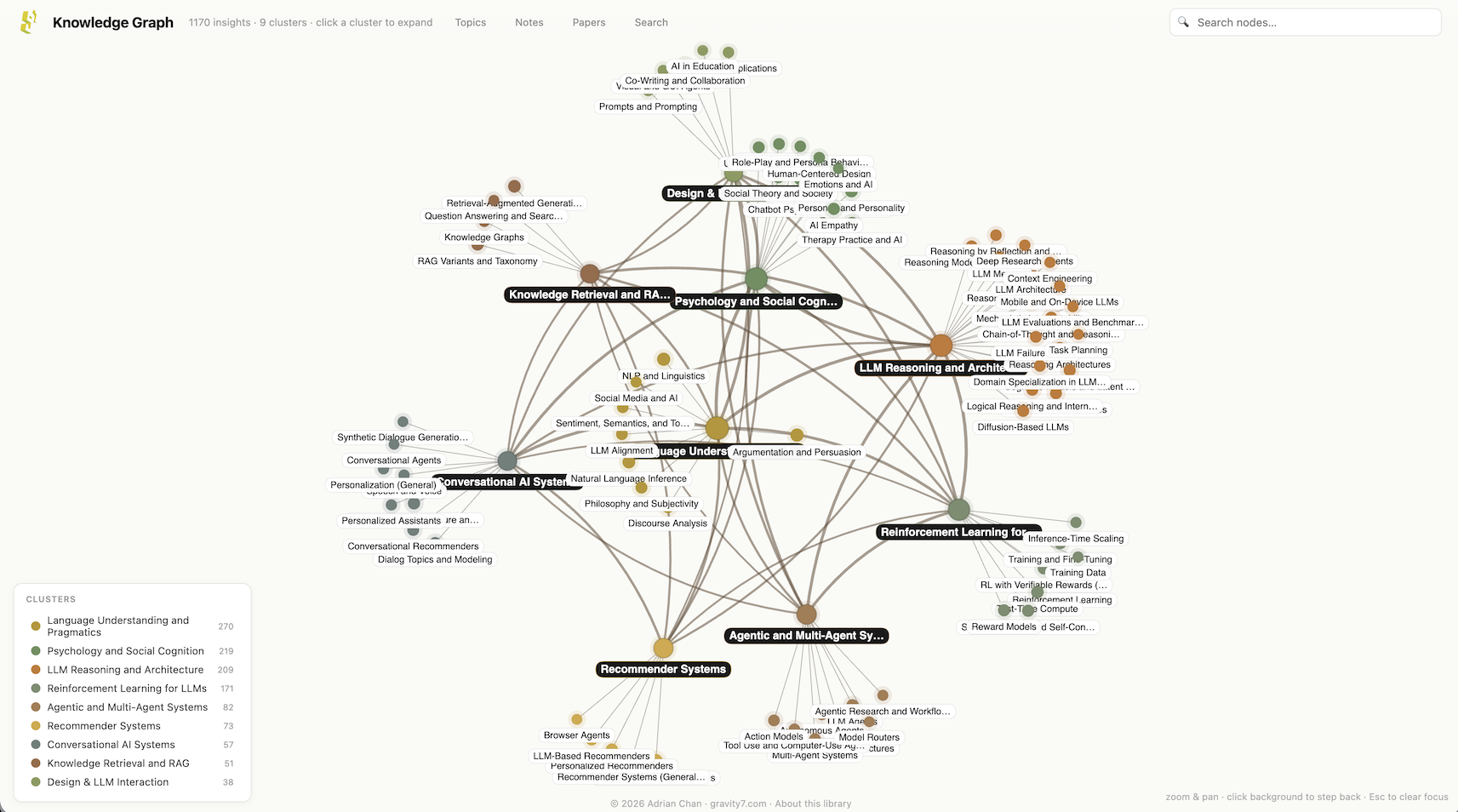
Whitepaper Archive
A browse and searchable vault of AI whitepapers that not only exposes white paper excerpts but surfaces questions, concepts, and related findings. Search by questions or browse by conceptual connections. My Obsidian vault of 1400 AI/LLM whitepapers exposed and made useful. Built with Claude, and a work in progress.
Try it →
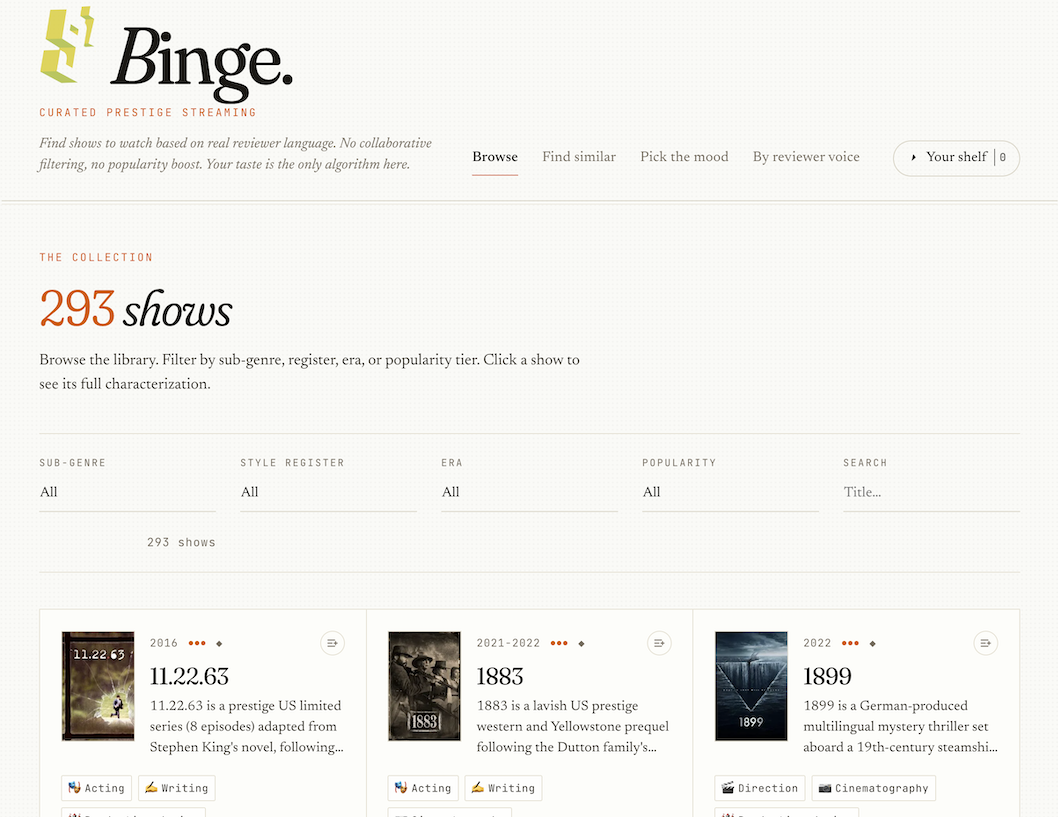
Demo
An Proof of Concept TV and Streaming Recommender based on reviews instead of "More Like This" recommendations. Find streaming shows based on what people say, think, and feel about them. It's a demo of using AI to mine semantic similarities in audience commentary. Built with Claude.
Try it →
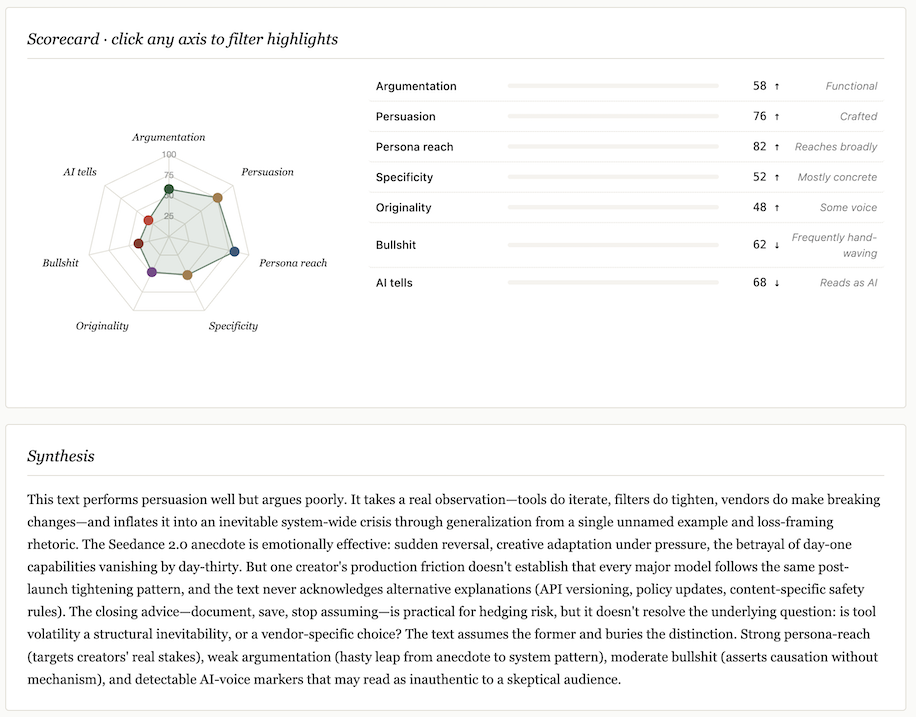
Text Analyzer
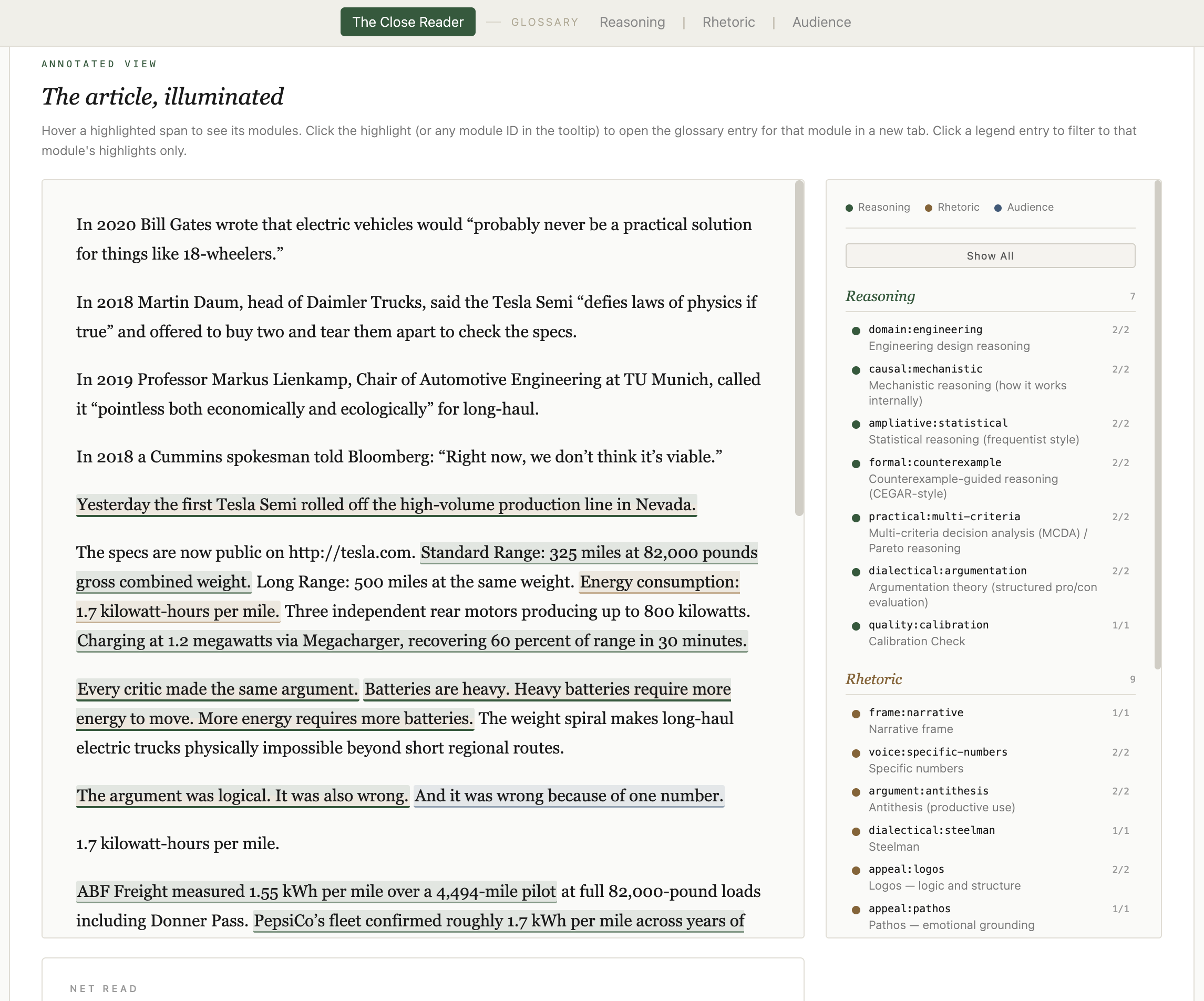
An Proof of Concept Studio Critic. Paste articles, social posts, web site copy and analyze it for reasoning, rhetorical styles, AI tells, and audience personas. Save the output as a PDF, downloadable, report card, or full image. This studio critic is a one-page flow and calls an LLM dynamically.
Try it →
Essay
An essay for ML and experience designers on conversation as shared context. I work with Claude through research on LLMs to shape an argument that the goal of AI-human interaction is interestingness in the experience.
Read →
Tool
Copy and paste a blog post, LinkedIn post, tweet, or other article into the window. Click to generate markdown. Copy that into Claude, ChatGPT, or another LLM. Copy what you get back into the next panel and view a linguistic analysis of the reasoning, rhetoric, and targeted audiences used in the post.
Open the tool →
Three-part essay
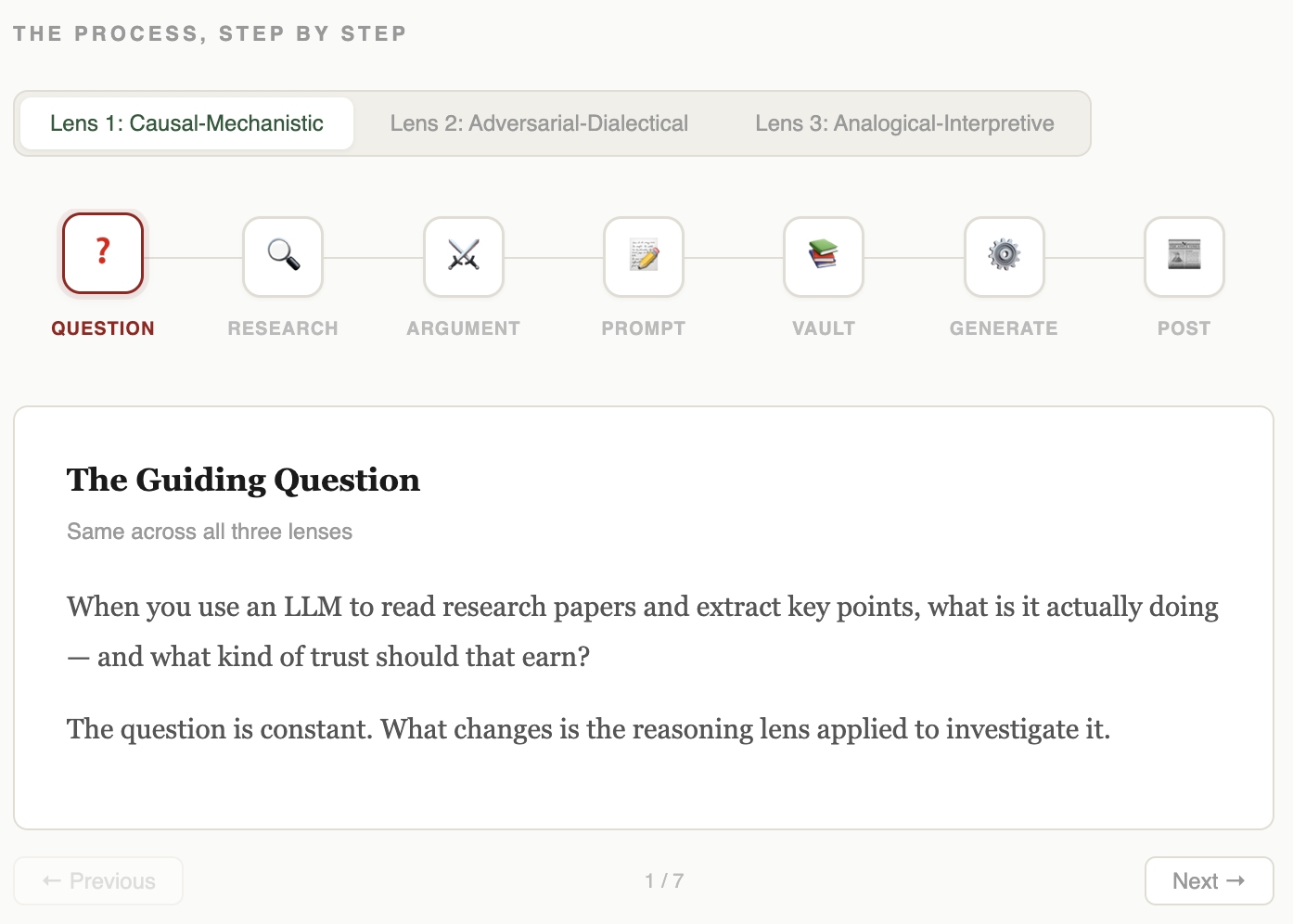
One research question, three reasoning approaches, three prompts, and three posts. A look at how prompting with different reasoning modules produces posts that make different arguments. Another experiment using Claude on an Obsidian vault of white paper research.
Read →
Essay
What impact will AI have on knowledge work, and on the role and status of the expert? I examine what makes expertise and how AI will reshape how it is produced and what qualifies it.
Read →
More posts written with Claude: Posts written from inside my Obsidian vault of AI white papers
- Conversational AI: LLMs expand the conversational capabilities and applications of AI, from open dialog to task-oriented dialog. Engaging and effective conversation are a matter for design.
- Design Theory: Design needs new concepts for the plastic and adaptive nature of generative AI. Speech and language as an interaction system, real-time generation as a technical capability, and many agentic architectures and integrations require us to update design concepts if not also methods.
- Domain-Specific AI: Domain-specificity is needed to make generative AI applications capable of handling the requirements of vertical commercial use cases. Design can contribute to assessing these needs within a domain and to shaping the performance of AI-based applications within it.
- Emotional AI: Emotions are added to voice mode conversational AI, but in order to make AI seem more human. The use of emotions creates novel design issues and considerations.
- Interestingness: In replacing search and creating experiences based more on discovery and exploration, language models can be designed to engage user interests more widely than with focused search. Design concepts for interest, over use, could help to shape these applications.
- Organizational Design: AI integrated into software and organizational applications will need to be designed, from task and job workflows to front-end interfaces.
- Personalization: AI will greatly expand its usefulness for end users when it is personalized to user preferences and data. Personalization is a design topic.
- Prompts: Prompts are an obvious application of design but are often considered engineering. Given the impact of prompting on LLM response generation, I think design theory needs concepts specific to prompting.
I have a list of the
whitepapers I have read here.